
A Culture of Generosity
The Taxi Driver
I held out all my remaining kyat1 bills in one hand as my taxi driver looked them over. The amount was a generous tip, about the same as the fare. This was a combination of generosity and practicality. I had made a habit of trying to leave a country with no local currency. If I had planned well enough, that meant I spent most of my cash and was left with just enough for a final taxi ride and a generous tip2.
This driver was particularly deserving. Halfway from the monastery to the airport, I realized I had not returned my room key. I asked the driver if he would be going back to the monastery soon and he nodded, smiled and said yes. He seemed more than happy to help me out. In fact he actually seemed delighted at the request.
So as I held out the bills, I felt this was a very sensible transaction. He was doing me a favor and in return I’d give him a big tip. However, he did not immediately take the stack of bills, instead examining them and fanning them out in front of me. I was a little put off at the gesture, unsure of his motives. Quickly it became clear, he was assessing the amount and deciding on what he felt was an appropriate tip. So he took some bills, leaving me with a half fanned out stack of bills. I gave a small gesture to tell him to take them all, not pressing the issue once his intention was clear. I have had times where someone of service felt like no tip was appropriate, based on the culture. I can’t remember another time that someone essentially bartered down their own tip.
In the end, his face had lit up more doing me a favor (returning the key) than from the tip. For him it seemed like the tip was just part of his job, and the favor was him doing a good deed in the world.
The Young Monk
I stood atop Mandalay Hill with a friend, overlooking a beautiful sunset. The view was amazing, a bright orange sky spreading over the entire city. What left a more lasting impression was in the opposite direction, away from the view. We happened to be watching the sunset on a day where local Burmese English learners would come to practice. We spent the most time with a group of students and with them several robed monks.
The monk leading the group told us his story, that his name was Ashin Kosalla and he had taken over a monastery that needed leadership. In the process, he started a language program for students in a classroom on the property. When he invited us to visit, we were enthusiastic about the prospect and were able to take him on the offer a few days later.
He was generously insistent on picking us up, and so he found us at our hostel (with his friend who drives, if a monk has taken all the precepts they do not drive) and brought us to the classroom. We talked a bit with the whole class, and then split off into two groups – my friend and I each taking half the class. The students practiced a bit of their English asking us questions. I did my best to answer clearly. It turned into more of an interview, resulting in me feeling kind of like a celebrity. When they asked about my favorite music, I started listing off some artists. Each time a familiar name came up, it would be met with an audible response from some students like “Oooh I know them!”. Culture being able to span the globe and create a small connection over something small like this felt very beautiful. The enthusiasm was contagious and we ended up having a very nice conversation and laughing quite a bit. I tried my best to engage with all of them – some were more capable and willing than others. They were fascinated about my travels, how I earned a living, and what life was like in California. It was a nice way of reflecting how the seemingly mundane parts of life can be interesting to others just by virtue of being different.
After the class, Kosalla gave us a tour of the monastery and explained how he had taken on this role of managing it. He was quite young and it seemed like a lot of responsibility. His dedication to service and helping these students was clear. To me, the prospect seemed intimidating and overwhelming and he handled it with total composure. He was a very gracious host, treating us to food and tea after the class. He treated our visit like it was a favor to him, when it had been one of the more wholesome and memorable nights of my traveling – I felt very honored to be able to spend the time there.
He kept me updated that he was still teaching years later, providing students with a valuable outlet even amidst the political strife in Burma.
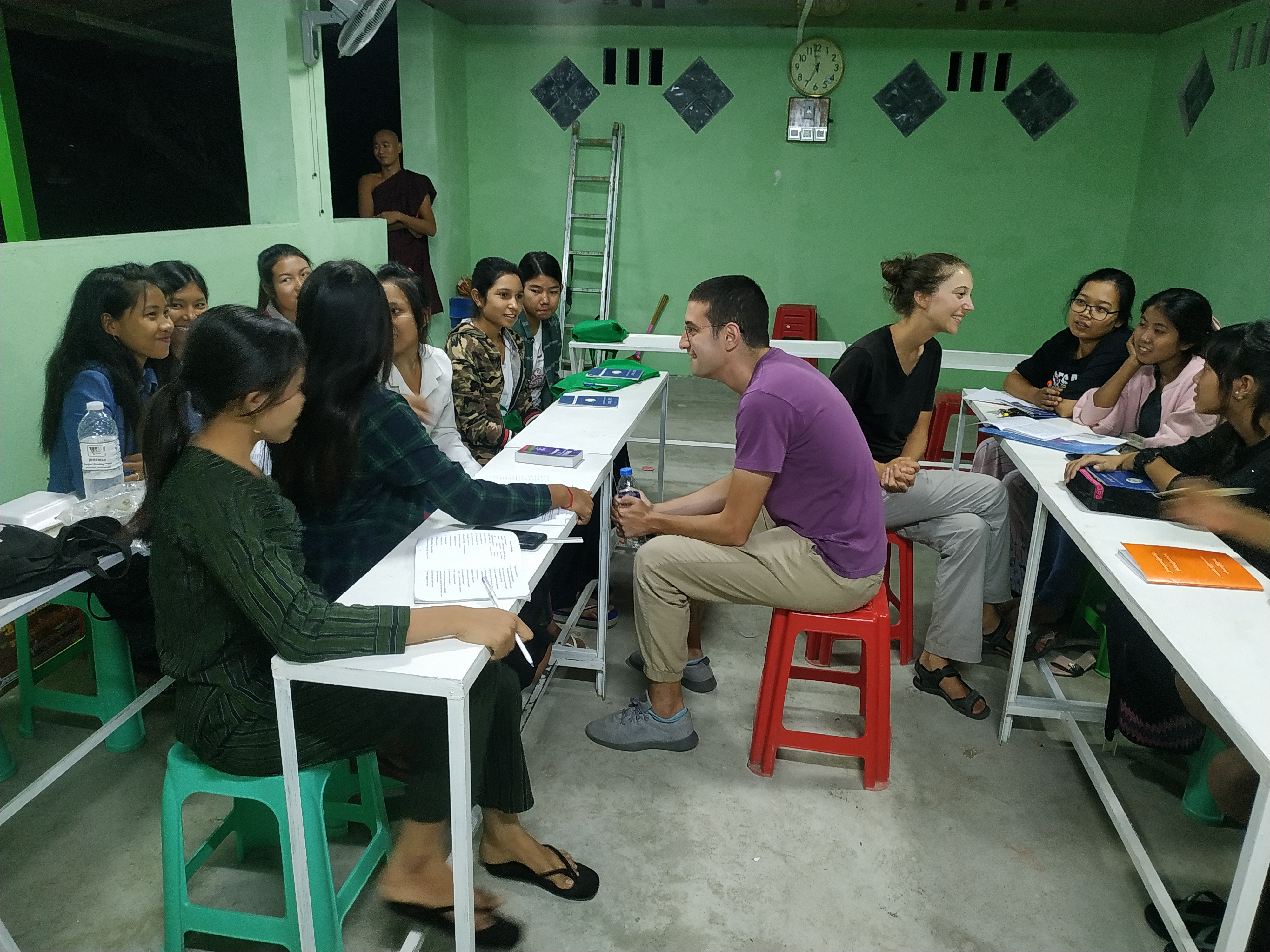 Trying to listen intently
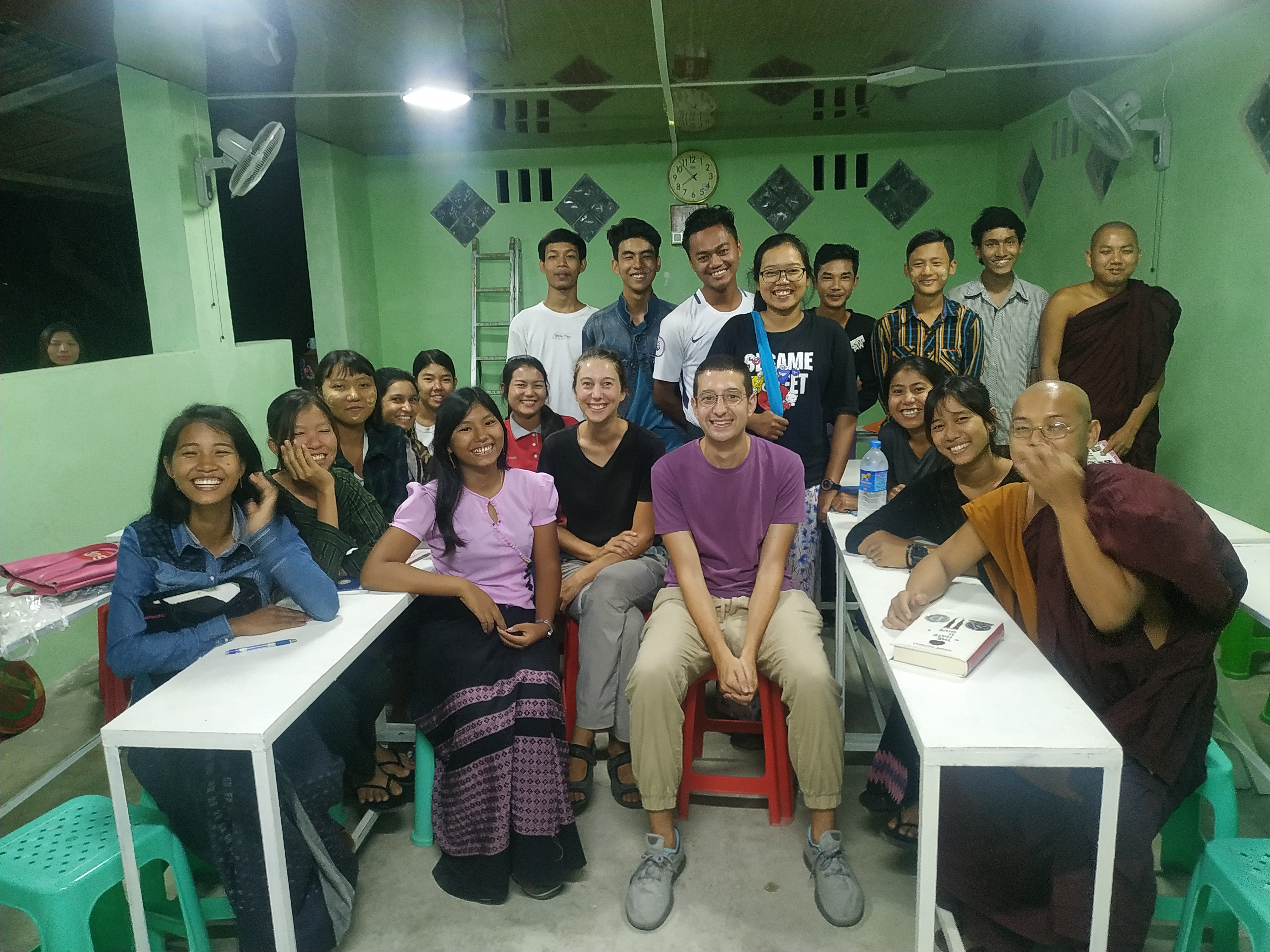 The full class
The Banh Mi
On the bus to Yangon (see Seat #12) I stuck out starkly as a non Burmese rider. The bus ride was a long journey, so midway through there was a stop for food. I prepared myself well enough with snacks, not knowing much about the trip.
A young woman named Sane waved me over to a table with her and her friends. She spoke good English and ordered me something vegetarian on the menu – a task I could not have undertaken on my own. As we were disembarking, she offered to hold my seatmate’s newborn as she gathered her belongings. And arriving on the streets of Yangon, she helped me navigate the chaos, laying out all the options of how to get to my hotel. I settled on a taxi and she communicated with the driver to ensure I would get there safely.
Sane’s generosity continued during my stay. I was mostly intending on resting, so hadn’t planned much to do. She offered to show me around one day, so we met in the central area and took transit to a shopping mall. She was insistent as the guide and city host that she would get me something. I felt that I should treat her instead, but I didn’t argue. I settled on a drink and she got herself a banh mi. She had really hyped up this banh mi, saying it was her favorite spot for food in the area. We walked out of the mall and found nice place to sit looking out at the water. We had a nice conversation, as she ate her banh mi and I sipped my drink.
A young boy came by, asking for food. Without a moment of hesitation or seemingly any mental processing, she gave him half her sandwich – the act flowed naturally from her. When we got up to walk some more, she saw the remnants of her donated sandwich and wrapper had been left on the ground. She picked it up and threw it out without any reactivity, no feeling of ungratefulness or negativity toward the kid. The whole process seemed totally organic to her being.
Generosity is a core teaching of the Buddha, considered one of the 7 perfections (paramis). It can be both a trait and a practice. My teacher Gil Fronsdal suggests a practice of carrying around a bill ($10,$20,$50 whatever feels appropriate) with the intention of giving it away to someone you meet throughout a week. Even if you never part with it, it’s a deliberate way of inclining the mind toward being generous. This is a very intentional way of examining both the act of giving and the attitude we have toward the act.
Our culture and values don’t always inherently lead to generosity, so an intentional practice can be useful. In Burma, from the taxi driver, to Kosalla, to Sane this generosity flowed naturally. There was no burden or debt or shame involved. I had debated how long to spend traveling versus at the monastery and am very grateful for how it worked out3. The people I met throughout the country taught me valuable lessons I couldn’t have gotten just from practicing at the monastery.
Living a life that is dedicated to generosity and in service of others can be challenging. At times I feel able to embody it, and it is energizing and connecting. Other times, I get caught up in my own life and the world feels much smaller. These three anecdotes persist as images in my mind: my hand holding out cash, the classroom of excited students waiting for my answers, and the scraps of a donated banh mi littered on the ground. They help me remember that seemingly small interactions can be a positive force in the world. In many cases, the generous person may not even have internalized the interaction as memorable. Yet it can have a profound impact on the receiver (in these cases, me). So, when I have the capacity, I try to live from this place of generosity with the hope to have an impact that I might never see.
-
The currency of Myanmar/Burma. Both the names Myanmar and Burma are used. Burma comes from colonial era, Myanmar comes from the military. Given the current situation and the people from the country being Burmese I’ll use Burma.
-
I couldn’t imagine driving in most of the world’s large cities. The aggression and awareness needed is profound. So I always felt like it was fitting to give a large tip to these drivers who I was reliant on to get me through the madness.
-
I had a 1 month tourist visa for Burma, this was before the political coup (as of March 2026 it is not advised to travel there from the US).